The acoustic transmission path from the loudspeaker to the microphone is usually referred to as a “secondary path” of the ANC system, whereas the acoustic transmission path from the noise source to the microphone is usually referred to as a “primary path” of the ANC system. The corresponding process for identifying the transfer function of the secondary path is referred to as “secondary path system identification”. In this context, this is the transfer of sound from the algorithm output (via speakers) to the algorithm input (via error microphone). This measurement represents the acoustic transmission path from the acoustic loudspeaker to the error microphone is applied to the FXLMS algorithm. The frequency response (i.e., magnitude response and phase response) of the secondary path system of the ANC system may have a considerable impact on the convergence behavior of the algorithm’s adaptive filter, and thus on the stability and the speed of the adaptation.
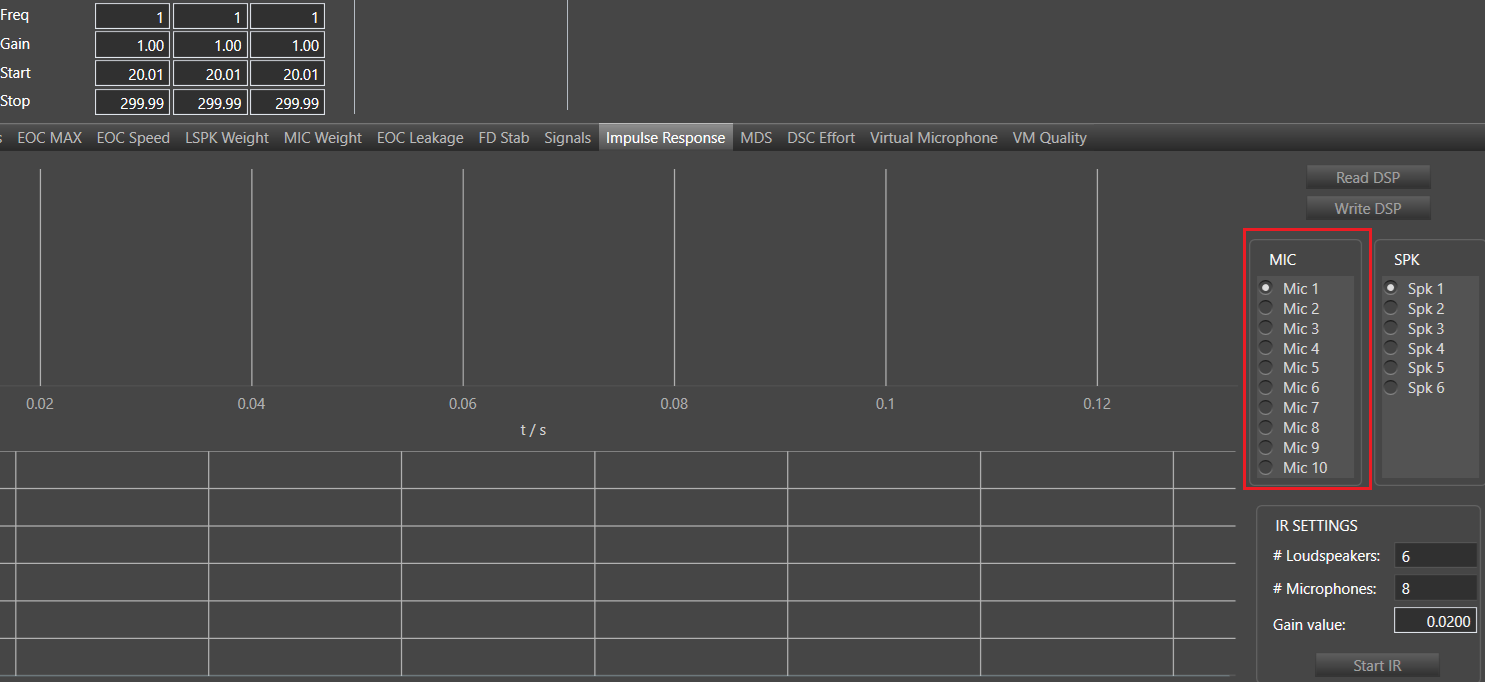
- Read DSP – read impulse response data from DSP
- Write DSP – write impulse response to DSP
- Mic and Spic radio buttons – is used for switching between microphones and speakers to see visualization of data for selected mic and spic
IR Settings
- Loudspeaker – loudspeaker from which will be send signal
- Microphone – microphone to which will be send the signal
- Gain – value of gain
- Save to flash – if the data should be saved in the device flash
- Start IR – start generating impulse response according to the settings above
From main menu user can export and import time domain and frequency domain data to the file.

The graphs in the impulse response tab are plotted based on the values from the following state variables
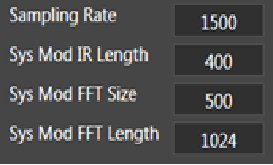
Make sure the number of microphones in the mixer settings is equal to m_NumElements(‘# of Mics:’ fromAudio Object property section).