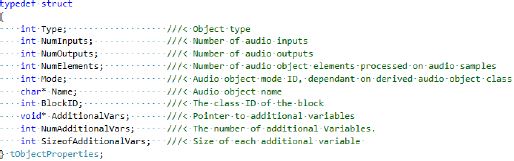
Once the design is completed in the SFD, it can generate files that contain data about the audio objects. This data is comprised of the tObjectProperties structure shown in Error! Reference source not found. on the right. The framework uses it to configure the signal flow.
To the audio object, this data is described in the Table below:
| Member | Description |
| Object Type | This is the unique class ID per type of object. |
| NumAudioIn | This is the number of input audio channels to the object in the signal flow. |
| NumAudioOut | This is the number of output audio channels to the object in the signal flow. |
| NumElements | This is the number of elements in the audio object. For example, for a Biquad filter, NumElements is the number of filters per channel of the Biquad. |
| Mode | This is the mode of operation of the object. For example, different modes in the Biquad denote different operating modes. One mode denotes a single set of filter coefficients per channel. Another denotes a distinct set of coefficients per channel. |
| Block ID | This is a unique ID per audio object in the signal flow. IDs cannot be used twice in the same signal flow. |
| AdditionalVars | This is the pointer to the additional object configuration data the tool sends to the framework. |
| NumAdditionalVars | Contains number of additional variables. |
| SizeofAdditionalVars | Contains total size of additional variables in bytes. |
In addition to the information available in tObjectProperties, a class ID per audio object is sent from the SFD to the framework so it knows what audio object to instantiate.
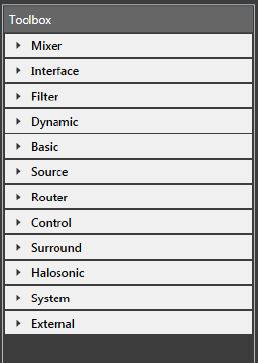
The class ID should be declared and added to the audio object IDs file in the platform where they are being developed. When building, the IDs for the objects that developers would like to use should be added as shown in Figure below.
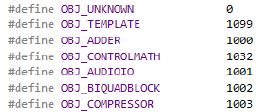
The class ID is an ID that is unique to each audio object class. If there are two gain objects in a signal flow, the class ID will be identical for these two objects.
Developers should implement the assignAdditionalConfig() function to interpret the additional variables as needed by the object. Dereferencing m accesses the additional variables_AdditionalVariables:
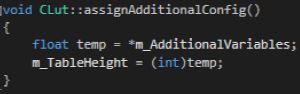
Each additional value is stored in four bytes of memory in float format.