The FIR MIMO audio object is a group of FIR filter banks associated with each input and output. They produce the preferred output signal to the speakers inside a vehicle, based on the input signals and the vehicle’s interior design.
Use case: FIR MIMO can be used for clever impulse and frequency optimization or applications such as individual sound zones.
FIR MIMO Properties
Below table describes about the FIRMIMO audio object properties and functionality.

| Properties | Description |
| # of Audio In | Enter the input value.
|
| # of Audio Out | Enter the output value.
|
| Number of taps for Hi filters | The number of filter coefficients (taps) for the high-rate path is configured using the m_NumElements. All channels in the high-rate path use the same number of taps.
|
| Display Name | Display name of the FIRMIMO audio object in signal flow design. It can be changed based on the intended usage of the object. |
Mode
The FIR MIMO audio object supports two modes of operation.
- Dual Rate mode
- ISZ mode

| Mode | Description |
| Dual Rate mode | In the GTT interface, you can select the number of filter taps and filter combinations. The default (and minimum) number of taps for the high-rate filters is set to 384. |
| ISZ mode |
In the ISZ mode, the object acts as a single rate (high rate) FIR MIMO object for accomplishing ISZ (Individual Sound Zones). For ISZ, the low rate path of FIR MIMO block is disabled, and the high rate path delay is fixed to zero. In addition, all the filter combinations are active by default for ISZ mode. You do not need to individually configure the additional configuration matrix to set the filter in each combination. Even though the m_AdditionalConfig parameters do not indicate that all the filters are active, the active filters can be viewed when we open the tuning panel for this object. The filter tap length should is fixed to 4096 only. This size must be fixed by you each time you switch to ISZ mode. This will be changed in future; where filter taps will be directly fixed by GTT when ISZ mode is selected. The max delay for hi rate filters will also be set to 0 only. These filters are designed using a highly specialized tuning algorithm, known as MFxLMS (Multiple Filtered Input Signal Least Mean square). Several constraints such as pre-ringing and post-ringing, frequency and phase constraints are applied to allow the CTC filter networks to be realizable with FIR taps to provide the desired response. There are two stages in the ISZ algorithm:
|
Additional Parameters
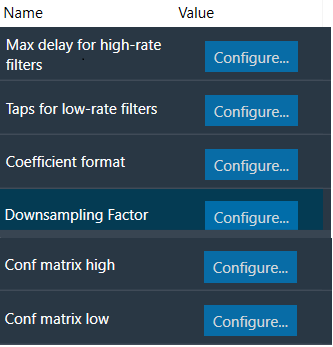
Below table describes about the FIR MIMO audio object properties and functionality.
| Parameter | Description | |
| Max delay for high-rate filters | Length of delay line for high-rate path.
|
 |
| Taps for low-rate filters | Number of taps for low-rate filters. All channels in the low-rate path use the same number of taps which can be different from high rate.
|
 |
| Coefficient format | Filter coefficient data format.
Note: When 16-bit fixed point format(Q15 format) is selected the filter coefficients should be in range of -1.0 to 1.0 |
 |
| Downsampling factor | Downsampling factor for low rate filters
|
 |
| Conf matrix high | Configuration matrix for high-rate filters.
Value:
|
 |
| Conf matrix low | Configuration matrix for low-rate filters.
Value:
|
 |
Tuning Parameters
For each filter combination in FIR MIMO, this object exposes these two tuning parameters to the GTT:
| Parameter | Description |
| Mode | The parameter is of the category “State” and therefore, the configurations done for Filter modes will be transferred to device only after device is connected. The mode of each filter can be set to:
|
| Coefficients | Filter coefficients can be imported from .csv files. The filter taps set in the GTT must match the taps of the filter being imported from the .csv file. |
Control Parameters
There are no control parameters available for FIR MIMO audio object.