Once the object’s overall description is provided, a mode description has to be provided for every “Mode” supported by the object. This number is specified in the section above.
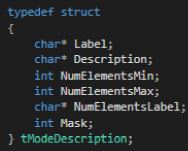
The table below provides a description of the variables required to describe each mode:
|
Member
|
Description
|
|
Label
|
The label of the mode described in the subsequent fields.
|
|
Description
|
Description of what this mode does.
|
|
NumElementsMin
|
The minimum number of elements permitted.
|
|
NumElementsMax
|
The maximum number of elements permitted.
|
|
NumElementsLabel
|
The label for the number of elements. For example, the number of elements in the Parameter Biquad block represents the number of Biquad filters within the Biquad block. This field is populated with ’Number of Biquads‘ for the Biquad block.
|
|
Mask
|
Four bits are used to indicate to GTT if it is possible to configure the audio channels and the number of elements (one for configurable):
|
The basic configuration information is written to the m_Descriptions variable in the audio object header file. The tObjectDescription structure displays all the variables necessary for configuration that are not dependent on the mode of the object.
For a mode dependent description, the tModeDescription needs to be provided. The example below describes and object that has 2 modes.

Once the mode description(s) is set, developers need to override the virtual getModeDescription method inherited from the base class CAudioObject.
