Harman Logo
AUDIOWORX
  • Home
  • Documentation
  • Videos
  • Release Notes
Harman Logo
AUDIOWORX
  • Home
  • Documentation
  • Videos
  • Release Notes
Harman Logo
AUDIOWORX
  • Home
  • Documentation
  • Videos
  • Release Notes

Table of Content

Signal Flow Designer User Guide

  1. Overview Of Signal Flow Designer
  2. Components of Signal Flow Designer
    1. Toolbox
    2. Design Operations
    3. Properties View
    4. Audio Object Operations
  3. Operations in Signal Flow Designer
    1. Pin Labelling
    2. View Audio Object Metadata
    3. Open column name Configuration Panel
    4. Upgrade Audio Object
    5. Change Audio Object Processing State
    6. Metering a Signal Flow
    7. Copy and Paste Operation
    8. Undo and Redo Operation
    9. Block Control
    10. Signal Flow Design Validation
    11. Securing Audio Objects
  4. Create a Signal Flow
  5. Tune a Signal Flow
  6. Native Panels
    1. Launching Native Panel from Signal Flow Designer
    2. Common Operation in Native Panel
    3. Launching Native Panels
  7. Additional Audio Block Configuration Parameters
  8. Harman Audio Library Service
  9. Support for Multiple Framework Instances
  10. Feedback loop in Signal Flow
  11. Compound Audio Object
    1. Create a Compound Audio Object
    2. Rename a Compound Audio Object
    3. Export a Compound Audio Object
    4. Import a Compound Audio Object
    5. Tuning and Editing Compound Audio Object
    6. Tuning Panel Compound Audio Object
    7. Multi dll support for CAO
    8. Delete a Compound Audio Object (CAO)

Audio Object Gain

  1. Basic Audio Object Gain Introduction
    1. Hello world!
  2. Basic Audio Object Gain Descrption
  3. Testing New Post 2025

Griffin Reference Projects User Guide

  1. Terms and Abbreviations
    1. Multi dll support for CAO
    2. Tuning Panel Compound Audio Object
  2. Purpose Of This Document
    1. Apply tuning to Compound Audio Object Template
    2. Testing New Post 2025
  • Signal Flow Designer User Guide
  • Common Operation in Native Panel

6.2.Common Operation in Native Panel #

Passing pin labels to native panels

The native panels display the corresponding names of the pin labels assigned to an audio object in SFD, thereby ensuring visibility. This feature applies to the listed native panels.
  • Delay
  • Gain
  • EQ/Biquad
  • FIR, FIRMIMO, FastConv
  • Limiter
  • Mixer
  • Router

On the Router panel first three characters of the out-pin labels will be displayed as a channel out names.

Look-up Table (LUT) panel has a separate mechanism to change the names of the channel.

Editing labels in native panels

You can modify Native panels pin labels. Double-click on a label, a text box will appear, enter the new name. The provided name will be updated both on the panel itself and on the corresponding pin in SFD. For audio objects that have a configurable number of channels, the new value will be set for both the input and output pins. However, for other audio objects, the value will be updated separately for the input and output pins. Depending on the panel, the displayed text may be trimmed if it exceeds the available space. This feature applies to all native panels except for the Biquad panel and the LUT panel.
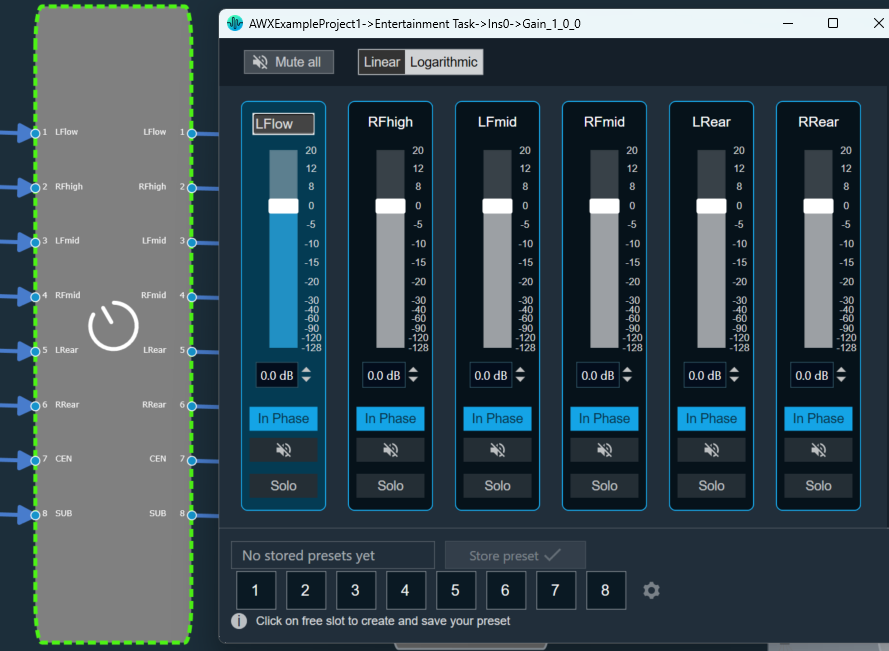
Resizing Native Panel

When the native panel window is resized, the controls are resized to fit the window. Following are the native panel which support resizing:
  • Parameter Biquad,
  • Crossover Biquad and
  • Tone Control Extended Panels

Native Panel Presets

Preset or Tuning sets can be used to store the tuning data set of the native panel. This control is available in every Native panel.

Creating a Preset

Follow the below steps to create a preset:
  1. On the native panel, tune audio objects signal flow.
  2. Select a free preset slot (numbers), enter a slot name in the text box.

    If you do not enter a preset name, it will take the default name of the New Preset.

  3. Click on Store Preset to save and store the preset. The preset will be stored in the slot you had chosen. The blue color indicates that the preset is applied to the respective native panel.

You can create several presets and switch between them to apply their values to the native panel by simply clicking on them. Once they are clicked, you can also override the preset by changing the tuning data of inner audio objects or the preset name. Graphical user interface, application Description automatically generated Resetting the Presets Follow the below steps reset a preset:
  1. On the Preset section, select the slots, and then click on the settings icon.

  2. Click on Reset Selected to reset the selected preset slots.
If you want to reset all presets of the respective native panel, click Reset All.
Was this helpful? Yes No Suggest edit
Last updated on October 7, 2024
« Launching Native Panel from Signal Flow DesignerLaunching Native Panels »
Help Guide Powered by Documentor
Suggest Edit
  • Careers
  • Contact
  • Sitemap
  • News

© 2024 HARMAN International. All Rights Reserved. Privacy Policy | Cookies | Terms of Use

If you are using a screen reader and are having problems using this website, please call (800) 645-7484 for assistance.