Harman Logo
AUDIOWORX
  • Home
  • Documentation
  • Videos
  • Release Notes
Harman Logo
AUDIOWORX
  • Home
  • Documentation
  • Videos
  • Release Notes
Harman Logo
AUDIOWORX
  • Home
  • Documentation
  • Videos
  • Release Notes
  • Getting Started
  • User Guides
  • Developer Guides
  • Reference Projects

Table of Content

Signal Flow Designer User Guide

  1. Overview Of Signal Flow Designer
  2. Components of Signal Flow Designer
    1. Toolbox
    2. Design Operations
    3. Properties View
    4. Audio Object Operations
  3. Operations in Signal Flow Designer
    1. Pin Labelling
    2. View Audio Object Metadata
    3. Open column name Configuration Panel
    4. Upgrade Audio Object
    5. Change Audio Object Processing State
    6. Metering a Signal Flow
    7. Copy and Paste Operation
    8. Undo and Redo Operation
    9. Block Control
    10. Signal Flow Design Validation
    11. Securing Audio Objects
  4. Create a Signal Flow
  5. Tune a Signal Flow
  6. Native Panels
    1. Launching Native Panel from Signal Flow Designer
    2. Common Operation in Native Panel
    3. Launching Native Panels
  7. Additional Audio Block Configuration Parameters
  8. Harman Audio Library Service
  9. Support for Multiple Framework Instances
  10. Feedback loop in Signal Flow
  11. Compound Audio Object
    1. Create a Compound Audio Object
    2. Rename a Compound Audio Object
    3. Export a Compound Audio Object
    4. Import a Compound Audio Object
    5. Tuning and Editing Compound Audio Object
    6. Tuning Panel Compound Audio Object
    7. Multi dll support for CAO
    8. Delete a Compound Audio Object (CAO)

Audio Object Gain

  1. Basic Audio Object Gain Introduction
    1. Hello world!
  2. Basic Audio Object Gain Descrption
  3. Testing New Post 2025

Griffin Reference Projects User Guide

  1. Terms and Abbreviations
    1. Multi dll support for CAO
    2. Tuning Panel Compound Audio Object
  2. Purpose Of This Document
    1. Apply tuning to Compound Audio Object Template
    2. Testing New Post 2025
  • Signal Flow Designer User Guide
  • Signal Flow Design Validation

3.10.Signal Flow Design Validation #

DDF Template Validation

In case there are issues with the DDF file generated by the toolbox during creating a device or modifying of the signal flow, an error notification will be displayed. GTT will recognize any audio object that is incomplete or has failed as corrupt. It is recommended that you should fix the DDF template of the affected audio object and proceed with your work.
  • If you import or open a project that contains a corrupted audio object, a warning message will be displayed. On opening the signal flow which has corrupted object, the corrupted audio object will be highlighted as shown below, and the same will be displayed in the compiler error window.
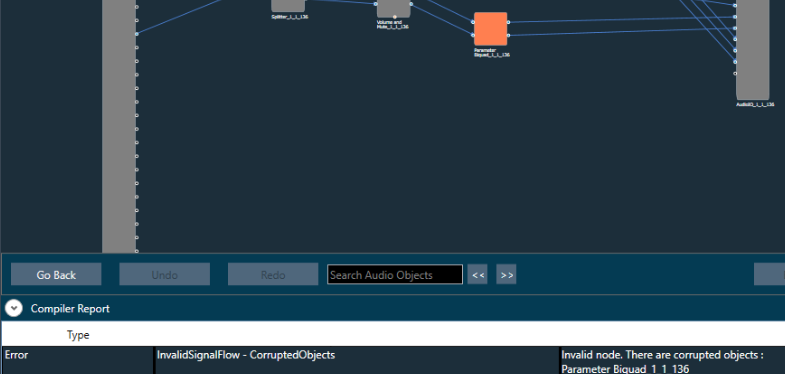
  • If the signal flow has corrupted objects on sending or exporting signal flow, the following message will be displayed. A screenshot of a computer Description automatically generated with medium confidence
  • If there is a mismatch between Sample Rate/ Block Length of instance signal flow and current audio object in the toolbox, then a warning message pops up and the corresponding object will be disabled in the toolbox.
  • If there is a version mismatch between the current audio library version and the version data on the device, a warning message appears asking whether to continue or stop saving.
  • If there is a tuning version mismatch between audio objects in the signal flow and audio objects in the toolbox, a warning message will be displayed, showing the tuning version differences, and those audio objects are highlighted in blue. A picture containing table Description automatically generated
  • If the Sample Rate/Block Length does not match, a message will be displayed asking if you want to continue or stop saving.

Additional Parameters Validation

The GTT will perform validation of input data in the additional parameters window, based on the information provided by the xAF dll for specific audio objects. The below validations are added on xAF and GTT.
  • ASCENDING
  • DESCENDING
  • NOTEQUAL
  • EVEN
  • ODD
  • EVEN_ASCENDING
  • EVEN_DESCENDING
  • ODD_ASCENDING
  • ODD_DESCENDING
The below figure displays the value entered should be an odd value. An error message is displayed to when an even value is entered.
Was this helpful? Yes No Suggest edit
Last updated on October 7, 2024
« Block ControlSecuring Audio Objects »
Help Guide Powered by Documentor
Suggest Edit
  • Careers
  • Contact
  • Sitemap
  • News

© 2024 HARMAN International. All Rights Reserved. Privacy Policy | Cookies | Terms of Use

If you are using a screen reader and are having problems using this website, please call (800) 645-7484 for assistance.