Harman Logo
AUDIOWORX
  • Home
  • Documentation
  • Videos
  • Release Notes
Harman Logo
AUDIOWORX
  • Home
  • Documentation
  • Videos
  • Release Notes
Harman Logo
AUDIOWORX
  • Home
  • Documentation
  • Videos
  • Release Notes
  • Getting Started
  • User Guides
  • Developer Guides
  • Reference Projects

Table of Content

Signal Flow Designer User Guide

  1. Overview Of Signal Flow Designer
  2. Components of Signal Flow Designer
    1. Toolbox
    2. Design Operations
    3. Properties View
    4. Audio Object Operations
  3. Operations in Signal Flow Designer
    1. Pin Labelling
    2. View Audio Object Metadata
    3. Open column name Configuration Panel
    4. Upgrade Audio Object
    5. Change Audio Object Processing State
    6. Metering a Signal Flow
    7. Copy and Paste Operation
    8. Undo and Redo Operation
    9. Block Control
    10. Signal Flow Design Validation
    11. Securing Audio Objects
  4. Create a Signal Flow
  5. Tune a Signal Flow
  6. Native Panels
    1. Launching Native Panel from Signal Flow Designer
    2. Common Operation in Native Panel
    3. Launching Native Panels
  7. Additional Audio Block Configuration Parameters
  8. Harman Audio Library Service
  9. Support for Multiple Framework Instances
  10. Feedback loop in Signal Flow
  11. Compound Audio Object
    1. Create a Compound Audio Object
    2. Rename a Compound Audio Object
    3. Export a Compound Audio Object
    4. Import a Compound Audio Object
    5. Tuning and Editing Compound Audio Object
    6. Tuning Panel Compound Audio Object
    7. Multi dll support for CAO
    8. Delete a Compound Audio Object (CAO)

Audio Object Gain

  1. Basic Audio Object Gain Introduction
    1. Hello world!
  2. Basic Audio Object Gain Descrption
  3. Testing New Post 2025

Griffin Reference Projects User Guide

  1. Terms and Abbreviations
    1. Multi dll support for CAO
    2. Tuning Panel Compound Audio Object
  2. Purpose Of This Document
    1. Apply tuning to Compound Audio Object Template
    2. Testing New Post 2025
  • Signal Flow Designer User Guide
  • Open column name Configuration Panel

3.3.Open column name Configuration Panel #

When linked to an object, the Smart LUT feature automates the process of adding column labels semi-automatically rather than manually.
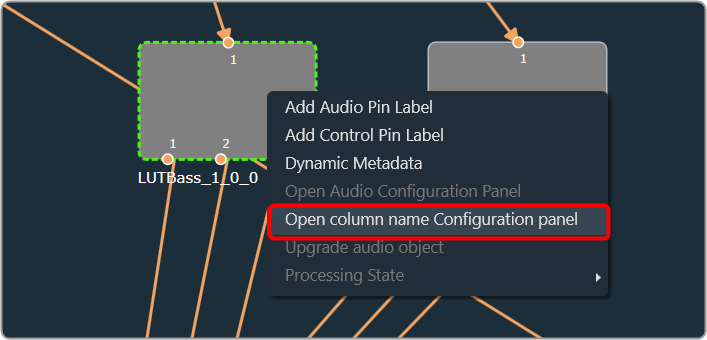
The “Open column name Configuration Panel” feature only supports LUT audio object.

Launching Column Name Panel

You can use this feature to choose which state variable values should be shown as column headers on the LUT panel. To begin assigning state variables to the columns of the LUT panel, simply open the panel by accessing the context menu of the LUT object in the SFD.

SFD must be saved before opening this feature else the state variables will not be available.

Following are the components available on Column Naming Window.
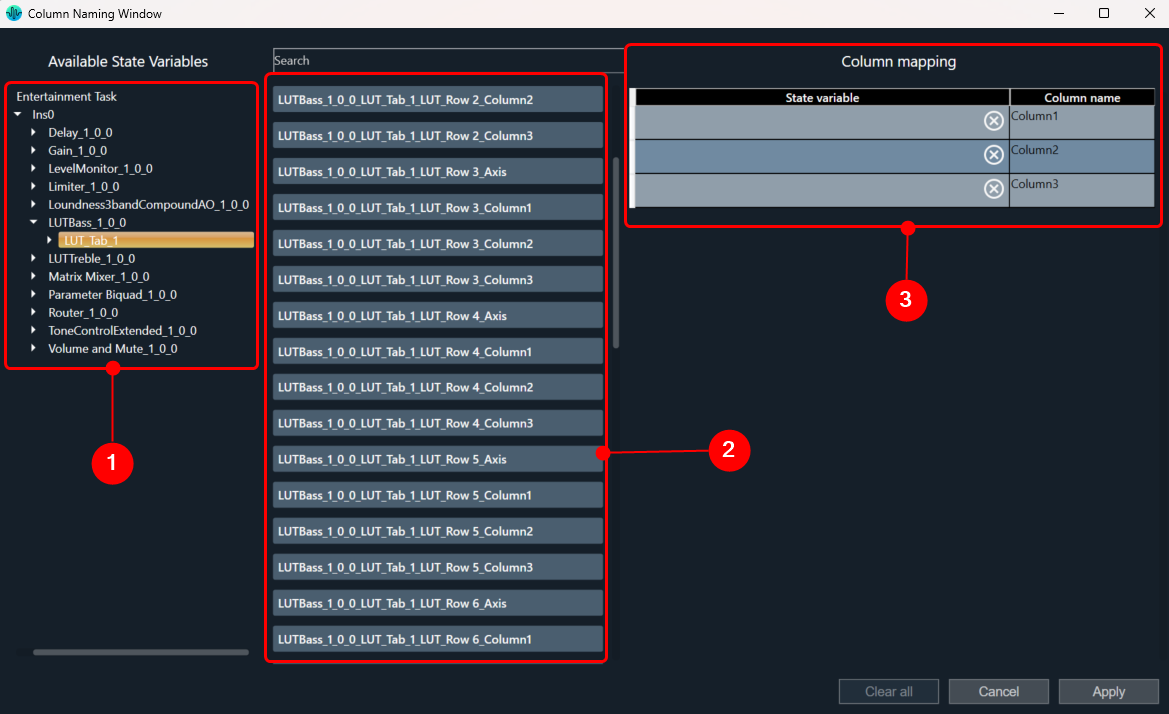
  1. Tree with all objects
  2. List with columns details
State variables associated to different objects State variables can be filtered in two ways: By clicking on the individual audio objects in the tree – each click will display the state variable of the respective audio object. Multiple objects can be selected to display their state variables. Or Use the Search bar and type required text, for example AO name (not case sensitive).

Selecting State Variable

Each state variable can be assigned to only one column. After assigning to column, it will disappear from available state variables. To assign state variables to a column, select the state variable and drag it to the appropriate column.
  • To Select: Multiple state variables can be selected by holding the CTRL key or by clicking the ‘Select all’ button above.
  • To Move: For moving selected variables, use the SHIFT key to hold and move the variables.
When all columns are completed, the ‘Apply’ button in the bottom right corner will become active. It will also be enabled if all columns are empty. To stop using state variables for naming it is necessary to open the Naming panel, clear all variables and apply.

Workaround for LUT Parameter Sets Unit Problem

This workaround is required for projects which are exported earlier than N+1 release.

  1. Import earlier exported project and open Signal Flow designer.
    • If all LUT objects belong to the same group, double-click on any LUT objects to launch the panel.
    • If each LUT object belongs to different groups, then launch the panels separately for each group.
  2. Close the LUT panels.
  3. Open Parameter sets view, right-click on column header of red color highlighted set, and click ‘Store’ context menu to get latest set values. You can observe the red highlights are cleared and units are removed for each state variable.
Was this helpful? Yes No Suggest edit
Last updated on October 7, 2024
« View Audio Object MetadataUpgrade Audio Object »
Help Guide Powered by Documentor
Suggest Edit
  • Careers
  • Contact
  • Sitemap
  • News

© 2024 HARMAN International. All Rights Reserved. Privacy Policy | Cookies | Terms of Use

If you are using a screen reader and are having problems using this website, please call (800) 645-7484 for assistance.