Harman Logo
AUDIOWORX
  • Home
  • Documentation
  • Videos
  • Release Notes
Harman Logo
AUDIOWORX
  • Home
  • Documentation
  • Videos
  • Release Notes
Harman Logo
AUDIOWORX
  • Home
  • Documentation
  • Videos
  • Release Notes
  • Getting Started
  • User Guides
  • Developer Guides
  • Reference Projects

Table of Content

Audio Object Developers Guide

  1. Purpose of this Document
    1. Terms and Abbreviations
    2. Requirements
  2. Overview
    1. Audio Object Workflow
    2. Audio Object Class
  3. Audio Object Configuration
    1. Design Time Configuration
    2. Advanced Design Time Configuration
  4. Basic Features and APIs
    1. Constructor
    2. GetSize
    3. Init
    4. Calc
    5. TuneXTP
    6. Control
  5. Advanced Features and APIs
    1. Audio Object Additional Configuration
    2. Audio Object Sub Blocks
    3. Audio Object AO Switch Processing State
    4. Debug and Monitoring
    5. Background Method
  6. Audio object Examples
    1. Example 1 - AwxAudioObjExt.cpp
    2. Example 2 - AwxAudioObjExtToolbox.cpp
    3. Example 3 - AwxAudioObjExtMemRecs.cpp
    4. Example 4 - AwxAudioObjExt.h
    5. Example 5 - AwxAudioObjExtToolbox.h
    6. Example 6 - AwxAudioObjExtMemRecs.h
  7. General Guidelines
    1. Hardware Abstraction
    2. Hardware Abstraction for Header files
    3. Memory Enums
    4. Overlays
  8. Adding external audio object into AudioworX package
    1. Building External AO

Device Description File

  1. Terms and Abbreviations
  2. Purpose of this Document
  3. Root Element
  4. Node Elements
    1. Communication Parameters
    2. Identification of Target Device
  5. Virtual Device
  6. Objects
    1. Object
    2. Definition of a Table Object
    3. Definition of a Biquad Coefficients Object
  7. StateVariables
    1. Common
    2. NumericalSV
    3. EnumSV
    4. FilterTypeSV
    5. FloatArraySV
    6. Float16ArraySV
    7. FixedPoint16ArraySV
    8. StringSV
    9. FixedPointM_NArraySV
  8. TargetValue
    1. Common
    2. Target Value
    3. Block Target Value
  9. Templates
    1. StateVariables
  10. Revision History

Griffin Reference Projects User Guide

  1. Terms and Abbreviations
    1. Multi dll support for CAO
    2. Tuning Panel Compound Audio Object
  2. Purpose Of This Document
    1. Apply tuning to Compound Audio Object Template
    2. Testing New Post 2025
  • Audio Object Developers Guide
  • Hardware Abstraction for Header files

7.2.Hardware Abstraction for Header files

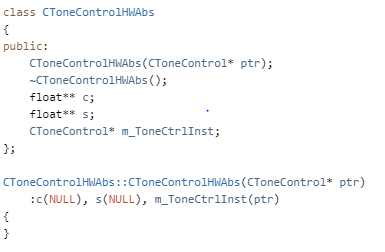
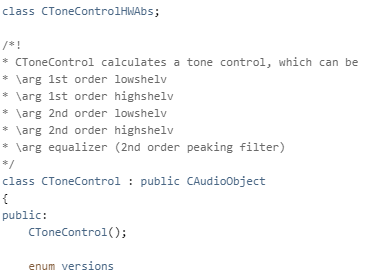
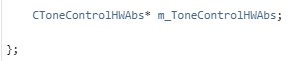
This hardware abstraction separates out platform specific member variables and member functions from audio object header file and keeps in hardware abstraction class. Implementation of this class is done in platform specific .cpp file. Accessing the hardware abstraction class members in audio object is done by forward declaring the class in later and instantiating this as a class member. Memory allocation and assignment is done for this instance in initMemRecord and init of the object. Sometimes, it may be needed to access audio object data members inside hardware abstraction class. This requirement is taken care by declaring a back pointer in hardware abstraction class and assigning it to audio object pointer in constructor function. Implementation for ToneControl audio object is completed and code snippets for the same is given below

Hardware Abstraction Class

Below is the implementation example of hardware abstraction class for ToneControl C66 implementation. Here m_ToneCtrlInst is the back pointer to access ToneControl data members in Tone Control hardware abstraction class which is initialized in constructor with CToneControl.
Instance of Hardware Abstraction class in Audio Object
Last updated on October 24, 2024
« Hardware AbstractionMemory Enums »
Help Guide Powered by Documentor
Suggest Edit
  • Careers
  • Contact
  • Sitemap
  • News

© 2024 HARMAN International. All Rights Reserved. Privacy Policy | Cookies | Terms of Use

If you are using a screen reader and are having problems using this website, please call (800) 645-7484 for assistance.